Showing posts with label Business School. Show all posts

Golf in Business Schools

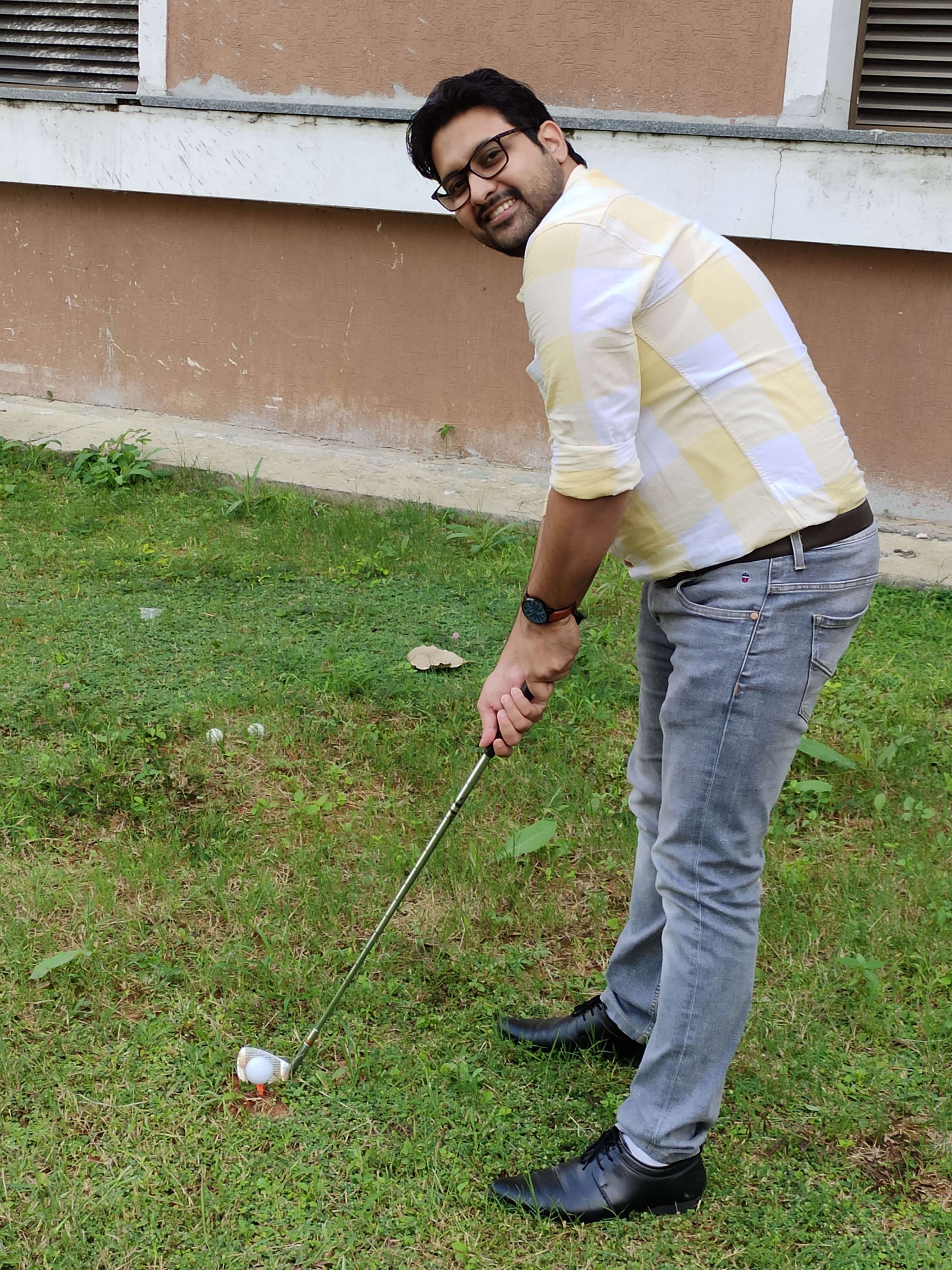
Prof. Harsh Vardhan above, and Arunoday, Rajat Verma below, try out Golf

at NMIMS Bangalore.


                                                         and of course, I do too.


 I have always wondered why Golf is not part of a business school -either as a part of the curriculum, or as an extra-curricular activity. There are good reasons why they say Business School students are successful due to networking which happens there. If that is the case, networking skills also take you places later, in the corporate world. And Golf's a great way to go that way. 

We were plain lucky to have an 18-hole Golf course 500 metres from home at Kirloskar Institute, harihar. Thanks to the Kirloskars, we played Golf like millionaires do-everyday!

At IMT Nagpur, a few years later, I managed to construct a green by simply asking our normal landscaper to create one and maintain it! All we did was procure a cup to hold the ball, and a flagstaff! And we played till I was there, training quite a few students (girls included) and a few MDP participants! They all enjoyed it, without exception. 

At IIM Indore again, I played on our cricket field, with imaginary greens on either side. Natural tee boxes were at the elevated ends. Again, I took a few MDP participants and faculty to play-they all enjoyed it. Some students too, on request, and they are now my friends for life!

Why is it that we are reluctant to do things that might do the student morale a lot of good? 

Hyderabad-Starting a B School


In 1992, I went to work for a new business school in Hyderabad called Vignana Jyoti Institute. This was an autonomous business school, and therefore we could devise our own curriculum. We were also starting from scratch- that means, we five or six faculty members would be the primary architects of the Post Graduate Diploma in Management (PGDM).

 The promoters were a group of mid-sized industrialists from Hyderabad, and this was their first foray into education. The director was from Administrative Staff College of India (ASCI), well known for its Executive Development programmes. There was a batch of twenty students in the first batch, many of whom were related to the promoters. But that was no problem, as they were mostly bright people. The small class size made it an enjoyable experience. We knew every student by name, and the quality of the interaction was high.

Sudhir, one of the students from this first batch would become a colleague at another institute a few years later, where he joined as a research associate. In general, the first two batches of students spread the good word, and Vignana Jyoti earned a good name in the city while we were there. Thomas, in H.R. , Venkata Rao in Quanti, Sudha in Accounting and Finance and Dayakar Rao in Eco were the colleagues, and I handled marketing. Some more joined after a year, but these four remained close because we had done things from scratch, together.

The institute was located in West Marredpally, a very good location to travel to for most of us. There was also a post office and an Irani café for other needs nearby. For lunch, we could go to Garden restaurant for a biryani, or Kamat for a thali. I ate a lot of biryani in the three years I spent there, usually accompanied by Thomas.

While at Hyderabad, we had an inspection from AICTE, for approval of the PGDM program. This program in India is considered as the equivalent of the MBA degree, and is made famous by the IIMs. Luckily for us, my paper had been published in a top American journal, the Academy of Management Journal, just that year, and that issue was available in our library. That got us some brownie points with the inspection team, and we did get the recognition from AICTE. This later became a coveted recognition, but not many parents believed then that PGDM was as good as an MBA. India could be the only country in the world where a degree is inferior to a diploma, at least in management!

We also managed to do a couple of Executive Development Programmes while at the institute. These were fairly basic, on Human Resource Management or General Management, but helped to network with industry. One of the memorable industry experiences was of Dr. Reddy’s Labs, who came and discussed with me at length one of the assignments I had given to my marketing students based on an article on pharma patents- Indian pharmaceutical manufacturers used to copy foreign drugs and used to change the process by which they were manufactured. They were protected by Indian law, which in 1995 did not recognize Product patents for drugs- but only recognized process patents. So, as long as you changed the manufacturing process, you were OK. This has changed since then, but the issue of intellectual property was hot then. I was impressed to see a pharma company taking the time to discuss this with me. Indian companies were not particularly proactive in reaching out to the academia then. This was much before the I.T. boom!

The ICFAI business school had just started in Hyderabad at around that time, and was probably suffering initial hiccups like high faculty turnover. But in about 10 years’ time, they grew by smartly scaling up, and expanding to different centres in India. They added 100 extra students every year, until their combined intake was higher than all the six IIMs put together!

One other major event I remember was the launch of Global Trust Bank, the private bank floated by Ramesh Gelli, in the post-liberalisation era. Earlier, many years ago, Indira Gandhi had nationalized all the private banks. This launch was significant for many reasons. Though the bank suffered from problems later and had to be taken over by another one under RBI directions, it paved the way for the emergence of stronger private banks in general, like HDFC, ICICI, and later, Kotak Mahindra, UTI  (now Axis Bank) and Centurion etc. It definitely spurred the public sector, nationalized banks to start thinking about their future survival.

One of my colleagues showed me an advertisement for faculty at Kirloskar Institute of Management in Harihar, Karnataka, and I applied, attracted by the salary quoted, approximately twice what I was getting then. I did not know where Harihar was, but I found out and went to two interviews, and was offered the job.

Running a Business School-Faculty


Faculty Management

I found faculty the easiest to manage, for some reason, in my few years as head of various institutions. According to me, the key is to treat the faculty as an equal unless you have some reason to exert your authority. I am not suggesting that this is the same as abdicating your responsibility or not thinking problems through. For example, assertiveness is required in some situations. For instance, I have had to sack faculty in exceptional circumstances too, but they were exceptional. I was also forced to take a call on performance evaluations at times, in unpleasant ways, but did not shy away from it.

But in the normal course of events, faculty are your biggest assets, and should be respected as such. They will actually go beyond the call of duty, and do, if their basic need- respect- is given to them by the bosses and the management (owner/promoter). This can happen in any level of school, not just in the top ten or fifteen. Sometimes, even the reverse- better in lesser known B schools.

How do you gain the confidence and respect of a faculty member of your team and help them perform better? First, you need to convince them that their development is aligned with the name and fame of the institute. Philip Kotler is an asset to Kellogg’s and not vice-versa. Srikant Datar has brought fame to Harvard with his book on Rethinking the MBA in recent times. Parasuraman of SERVQUAL fame is better known than his university, in fact. So, a faculty member can actually play a major role even in branding his institute. But above all, he/she must contribute more than just good teaching. He could develop his training skills by teaching in Management Development Programs, or publish scholarly work in journals of repute, or write a text book (where would Kotler be without his famous text?).

Value-added Activities
I call these value-added activities, and these are as important as teaching. Of course, your students will remember you if you teach well, but the whole world will salute you if you do more in different forms suggested above. You could also lead a Ph.D. program or at least be a guide to some doctoral students, or start a journal for your institution, or do some more innovative things- for example, consulting. Faculty need to excel in at least two of these besides teaching. And then you will automatically become a much sought-after person in your field of expertise.

Setting Expectations
At PESIT, Bangalore, I first set out my expectations that every non-PhD faculty would get a PhD. To their credit, every single faculty who did not have one, enrolled for one, and we had 100% faculty who either had one or were registered for one- including a 58 year-old! It helps to set out expectations in terms of teaching, research, Ph.D., training, and academic administration.

Let me tackle some of these. Academic administration is the toughest. Most faculty members ask, why should we do this (unpaid labour)? My answer is, I expect you to be a Dean or a Director of a B school in a few years. These are valuable experiences along that path. I was once a placement chair in an institute. Not a very good one, because my selling skills were weak. But I learnt about how to handle students and placement chairs after that stint, which was to prove useful to me later on.  I was also an MDP chairperson at another school, and a research chair at IIMK, in addition to coordinating admissions and the Post Graduate Program at various stages in my career. All of these were useful stints, and helped me grow. I think one of my major successes-appointing the right people for the right job, in some of my later stints as head of an institution-came out of these admin roles I performed.

Teaching
Load for teaching needs to be defined, and not exceeded beyond a maximum. It is an exhausting process when you include preparation and evaluation (in an autonomous school the faculty does this himself), particularly when class sizes are large. Therefore, to find time to do other things that are important, teaching hours need some control. Unlimited teaching may produce a good teacher incapable of adding value to himself or the B school over a period.

Publication
Either empirical research or case study writing/publication is a must to prove that you are pursuing current knowledge. Contribution to the profession is also measured through publications. Accreditation agencies and ranking agencies evaluate a B school on the basis of their faculty’s publications. Therefore, for various reasons, publishing your work is crucial. Training and hand-holding of new faculty may be needed to help them achieve this goal. Journal lists of potential journals to publish in must be generated and updated. You could start an institutional journal. Research seminars by internal faculty can be organised regularly for sharing of work in progress.

Conferences
Conference papers are more easily accepted than journal papers, but do need effort. They can be co-authored with faculty from other B schools or your own. The presentation of papers is a break from routine, and can expose you to new ideas as well as new peers. I have found a co-author at one conference and it led to a decent international publication.

Industry Interaction
This can take several forms. If the budget allows it, faculty must get industry speakers to come in to their class for a couple of sessions in a course. This builds a network with industry, and exposes the faculty to some industry jargon and events. Also, consulting or training opportunities may come as a result of these interactions.
Industry seminars on a theme that is current or trending, can be organised as a day-long event, with the help of student interest groups. This may create leads for placement or live projects.

Evaluation of faculty
Usually a mix of criteria, that include teaching quantity and quality (measured through student feedback and other criteria such as novelty, etc.), publications, and service to the institution through academic administration are used in evaluating faculty contribution. You can devise a method that suits the goals of the organisation. But this needs to be clarified many times orally and in writing. Goal-setting for the institution also needs repeated discussions with individual faculty and in groups.

International Exposure and Development
You need to handle faculty with care, as an important resource. Their developmental needs can be met through exposure to training, foreign teaching, and networking opportunities. Future leaders can be groomed through such exposure.

My Past Bosses

My Bosses over 20 odd years


This one should be a super hit (as they say in Bollywood), as bosses and spouses are the most talked about (maligned?) people on earth.

Boss at the Ad Agency: A lady was my first boss at this workplace. I was a fresher, and I felt she did not make use of skills (ha!) that I had. But I did learn how to be pushy from her. She was not that good at her work, but adequate for a small agency that had no ambition. My (women) colleagues did not like her one bit, and my (male) colleague Sunil Jariwala who was in media, was also fairly cool. She wrote my first appraisal in my work life, and it was not flattering. I did not stay long enough for the second appraisal.

Market Research Company: At my second job, the bosses (three of them) I had (C.K. Sharma, Matthew Paul and Shyam Sunder) were some of the nicest guys on earth. They were very democratic, and being from a similar background as mine (an IIM), maybe, were understanding. They gave me challenging work to do, and appreciated good work when I did some. I was rapidly transferred to their biggest territory (Mumbai), and they were cordial even when I left to go to the U.S. I really enjoyed my work, though the pay was not so great.

My Ph.D. guide at Clemson (Mike Stahl) was great, a very focused guy, and but for him, it would have taken me much longer than three years. He was quick with feedback, and pushed for acceptance from other members of the committee if he was convinced. When I see some struggling doctoral students in India, I am reminded of my good fortune.

At Lander, my Dean Dale Molander was very respectful (because I could teach quant subjects?), and supportive. Quanti teachers got a lot of respect in the U.S. anyways. He was also a very straight-talking and easy-to-get-along-with guy.

My first Indian academic boss (A Jesuit Father): At Bhubaneswar, I was aghast when I attended my first faculty meeting. It was more like a discourse in a Sunday Mass, and the boss was unstoppable. Anyway, I got into a fight and left fairly quickly, but it bothered me for a long time, coming from a democratic system in the US where faculty even voted on critical matters. This guy was also vindictive, and left a bad taste in the mouth.

Boss at Hyderabad: An officer and a gentleman is how I would describe this guy, ex-Air Force officer and ex-faculty member at Administrative Staff College (ASCI), who saw us through the initial few years. We jelled well. It was a nice experience while it lasted- about three years.

Kirloskar Institute: Boss No. 1: He had pedigree (had been at IIMA for donkey’s years), and good teaching style, but was somewhat introverted. We got along fine, and I learnt how to invest in infrastructure (intellectual) from him. We had a great collection of Harvard cases, films and business books. One of the films we used there, called “Who Killed the Sale?” was a classic.  We also had great visiting faculty from IIMs and elsewhere. We also valued people- salaries were twice those at other colleges.


Boss No. 2: Though not as illustrious as his predecessor in management training, he was a great human being, respectful and nice to work with. He succeeded in getting an MBA program going at Harihar, and genuinely wanted the good of the institution and all stakeholders.


Boss No. 3: A devil incarnate, and my first inspiration to strike out as a director. Absolutely without scruples. I had the most altercations in my life with this guy, and I don’t think they had any impact on him, as his skin was too thick. Teflon coated, as U.S. president Reagan was once called. (Some Teflon may be good for the boss, but not too much.)


At Lucknow: He was a director with a reputation for leadership, and I had no trouble at all from him. He had a lot of finesse in dealing with people, though it was apparent that there were many who did not approve of him. But then, a leader or anyone in an administrative position can rarely please everyone. One of his bad traits was getting less than qualified people to teach at IIML, but most IIMs were in dire straits for faculty, so maybe there was some good in that. I don’t know.


Other academic bosses: Boss No. 1: A very shrewd guy, managed his self-interest, but not that of his team. Did not have a clear plan for the institution, except claiming to be high and mighty. Lived on his past reputation, mostly.


Boss No. 2: Another inspiration for my directorial ambitions. Had a severe case of verbal diarrhoea, and people ran miles to avoid getting into the trap of his one-way communication. But a relatively ego-less guy, and therefore easy to get along with if you could tolerate the earlier-mentioned fault.


I become the boss: I also have a few (!) faults. I am the big-picture guy, not too target-oriented, tough, and so on, but I believe I am easy to work with (mostly), and concerned about an individual’s development. I also delegate extensively, and (I believe) give enough rope to people to hang themselves. I have no illusions of greatness (either mine or anyone else’s)- I believe we are all fallible.


Copenhagen Business School

Copenhagen Business School has sent a few of their students in an innovative two-week program that IMT Ghaziabad has devised for them. The group are doing an entrepreneurship course and will attend classes, meet entrepreneurs, and do a bit of consulting projects in teams. They will also take a day off to sight-see, and visit Agra.

This is one of the bigger B schools of the world, and the students are from different countries in Europe, doing an international business or I.B. program at their B school.

IMT Ghaziabad has a lot of partnerships (about 75-80) that work at different levels, with exchange of students for a term being one of the regular ways of interacting. We now also have a Doctorate in Business Administration that enables corporates to make a transition into the academic world.

We all learn a lot from doing these innovative programs. Cheers to more such.


IMT's International Ties

It is almost a fashion to tie up with international institutes or universities these days. Amid all the madness, IMT Ghaziabad stands apart for its serious attempt to get on to the global stage.

We have close to 80 MoUs signed with various international business schools, of which many are active and ready to explore initiatives beyond student exchange, important though that is.  Around 80 students  participate in our 2-way exchanges every year. I have met three teams from international universities in the past week alone, who are potential partners. And we are talking joint research and other ways of partnering.

Very interesting indeed, and lots of possibilities, going ahead. We have also applied for accreditation from AACSB, considered the best in the world, and are working  towards a new and revamped curriculum and modes of delivery/pedagogy. We already have a dual country MBA along with IMT Dubai.

Wedding in Chennai

 Went to Chennai for a few days, after quite a while. I used to attend a December conference at Great Lakes Institute for a long time. This ...

These Were Liked a Lot