Showing posts with label Teaching. Show all posts

Teaching Golf Over the Years

 Over the years from Nagpur (2009-13), IIM Indore (2013-2020), NMIMS (2020-22), and Prestige University (2022-24), I taught Golf basics to a wide variety of students including MDP participants from industry, MBA/BBA/Ph.D. students or alumni, and faculty members. Staff too. Some pictorial reminders-


Professors and families, above, IIM Indore


Sohni Roy, colleague, at an Indore Driving range.

Prachi Jain above, and Akansh , Ph.D. students, IIM Indore


Below- Radha Ladkani, prof., IIM Indore


Above- An unusual one, a kid we met at Kodaikanal Golf Club, is being taught by a caddie, while her Mom and we assist.


Students above, and profs. - Tnameet Sahiwal and Prerona Baruah- below, NMIMS Bangalore


Students from NMIMS above, and IIM Indore (Anusha and Shantanu), below


Snehal, visiting faculty at Prestige above, and Veronica, Argentinian faculty who visited Prestige.


Juhee Singh, faculty at Prestige, and below, students..


Below-Natasha Kothari, guest faculty, Prestige

Below- Gayathri, a friend of Prof. Preeti Ravikiran.. she's a Cricket umpire for India.
at NMIMS Bangalore


Can We Do Things Differently?

 Most of the time, the answer is yes. But we don't. 

Teaching- there are many ways to teach so that students enjoy the process, and learn better. But we don't try hard enough..

Improving Admissions in Institutions- many untried ways exist. Paying commissions to agents is not one of them.

Recruiting faculty- Going out to meet Ph.D. scholars instead of just advertising.. how many have tried this? I have, with some success. At a new university..

Motivating Faculty as a leader- having a tea and a chat with them regularly helps. Have a chai room in your institute if you don't. 

Spending Your Time- in a way that you enjoy it, doing things you like, minimising things you don't like to do (visiting govt. offices is one I don't), and so on.. listening to the radio doesn't cost anything, for example.


Retirement- Possibly for Good

 I have contemplated retirement, often. Of course, life does not always turn out the way you think it will. So it was that I came to work in Kolkata. But circumstances have forced me to relook at life's priorities. And it is very likely that I will soon retire from full time work. 

It gives you enormous freedom to think, and indulge.. in things that you could only dream about, and occasionally partake of. This may include some travel, some reading, some Golf, meeting people at various places, or in town, doing new things, and listening to music. Of course, family responsibilities, as they are, will be a part of it too.

I am of course, open to occasional forays into teaching if there's any demand from an institution. But mostly, not admin. positions that are devoid of student interactions.

Pune will be the base, or adda- not the Bong version, but the Marathi or Hindi one- as far as I can tell. Mumbaikars, beware. You might see more of me in the months to come!

It has been good while it lasted, through corporate jobs in Advertising and Market Research, and teaching through my Ph.D. to post-Ph.D. days, in the US first, and then in India.

Some great colleagues and students who turned into friends along the way, are my billion-dollar wealth.

Academic Life and Its Perks

 I had a colleague, Madhu Karmakar, who neatly divided his life into two parts- academic and non-academic.. while being a prof. But what I am talking of is a life in academia versus in any other profession, particularly the corporate life.

Pluses of Academic Life

You can read a lot. It's part of your job too.

You are your own boss-in the class if you are teaching. Outside the class too, when you are ideating, writing a case, or a research paper. After writing, if you want to publish, there are some hurdles..

You can travel, if your institution supports this, for conferences, or faculty development programs, etc.. I have been fortunate.

You meet more intelligent people - students in higher ed. particularly, colleagues, and so on, many of whom are smarter than you. So you learn a lot.

In some countries, there's no retirement age.. even otherwise, part-time activity can continue for a long time..

You can have a social life, if you wish..

Negatives

The Publish or Perish menace is all-pervasive. 

So is documentation, with all sorts of accreditations up for grabs. AMBA, AACSB, EQUIS, NBA, what have you..

Teaching loads are high in institutions which are not in the top few, autonomous variety. Also in many private colleges and B schools. 

Some institutions treat faculty shabbily, with workplaces that are like corporate cubicles, or worse.


Reflections From Academia

 Just as corporates have their learnings from the company they keep (or the company that keeps them), academics have our own.

When can one call an academic successful? When he publishes a huge amount of papers? When he earns a lot? 

Practically, I would say, in order of ranks 1 to many, these could measure his success-

1. Touching lives of students in some way- inspiring them or showing them the path to self-discovery.

2. Treating the students with respect- lots of teachers fail on this count.

3. Blending practice with theory or concepts in the same course, in a trimester or a semester.

4. Doing contemporary projects with or without industry cooperation. Case writing could be one kind.

5. Bringing his/her experiences into the class. Therefore, getting those experiences too..

6. Using innovative learning methods, experimenting with many.

Research Shows- 5

My research into the academic work shows-

That teaching-learning is effective only when it has a marketing orientation- not that students are customers.

I mean methods followed need to be appropriate for the students on hand. Tough projects for school kids are essentially done by parents or others, for example.

In-class work is as important as home work.. maybe more, as it can be directly supervised. 

Collaboration needs to be taught through examples, like group assignments.

Evaluation should be multi-modal, with a viva of some sort, or presentations, included.

Feedback should be honest, and if possible, constructive. 

Clear goals written in a course outline help.

Many teachers fail on some of the above.


Not Just Presentations -Pedagogy

 Learning Methods are many, and a professor can invent or modify some existing ones too. Assignments that include a presentation are a good tool to build communication skills, but other objectives can be served by using other methods. A few I have used-

Blogging

Role Plays based on short cases

Just role plays to learn about Qualitative Research Techniques such as Focus Groups or Depth Interviews. Each of these requires a different skill-set. 

Questionnaire-building or modification to suit changing times. Can be a group exercise done in class.

Bidding to simulate auctions of different kinds, in Negotiations, or in Digital (Paid) Marketing 

Shooting a small video/reel to advertise a product/service

Captioning a post with attractive copy.

In addition, you can use exams as a learning tool by being creative in designing questions that test thinking ability or application orientation.


Classrooms and Learning

 My experience tells me that learning happens better when both teachers and

students get creative. A conventional classroom has limits, and combined with

traditional methods of evaluation of students, it results in short-term learning at best,

mostly meant to pass exams or excel at exams.

If learning with impact is the goal, as it should be, a lot of unconventional approaches

to learning are needed. My view is that some kind of action-based-learning works

best, and can be combined with some presentation or other means of feedback from

the facilitator/teacher.

I have experimented with role-plays involving case studies/situations, projects with

some data collection and analysis, simulation based on a computer program, and

making of video content or writing blogs and trying to get readership. Of course, a

few more types of exercises such as writing an email trying to persuade people to

buy something and competitive bidding exercises.

Teaching Can be Fun

 Learning and teaching can both be fun, if the conditions are right, and the teachers are open-minded. What methods they use to impart learning makes a lot of difference.

Recently, I had occasion to handle a couple of Research Methods sections at Prestige University. The students did a group exercise for a project, choosing a brand that they would base some consumer research on.

Pics from that session. 


What I Got From My Employers- 5

 Ok, Getting down to IIM Indore and the 7 years spent there. A beautiful campus, with a hill-top academic block inspired by Hindola Mahal at Mandu. And a nice Cricket ground that I used for Golf training and practice.

Did a few unique training programs, including some for the Tata Retail group, Whirlpool, and Hindustan Petroleum- both onsite and offsite.

Taught Digital Marketing for the first time, learning things as I went along. Wrote a couple of cases and co-edited a book on Digital Marketing cases.

Had a lot of good students- too many to remember- in my Marketing Research courses and Seminar on Tourism Marketing too, plus Digital Marketing. A group of students I mentored got the Asia Pacific title in GOMC, an online international marketing challenge that Google runs, in 2017. A group of six students worked for a client called Bhalaje Photographers.

Made many friends, across teaching areas. Attended conferences in Japan, Cambodia, Vietnam, Sri Lanka, and went to learn things in FDPs in NUS' summer school in Singapore-twice! I was the oldest participant by miles!

And met a lot of doctoral students who became good friends- from different academic areas too! Used the cricket ground to play and teach Golf to a few students, faculty and MDP participants.

Random Thoughts About Teaching Life

 Life in teaching is strange, in multiple ways. You go through a lot of perspiration, not knowing how the students will receive the preparation. After the class, sometimes there is exhilaration, and sometimes, frustration. 

But there are many moments that make you thankful about having chosen to teach, rather than sell soap (note, I have nothing against the soap-makers- they are doing a brilliant job of keeping us clean). Or being a politician. It requires too much energy, for one.

The quiet contemplation is one big plus. (Reading is another). Always being on tenterhooks as you prepare for the next class (not calling it a lecture, deliberately. I think the Last Lecture was delivered a few years ago). 

Planning an activity, an exam or an assignment was my big thing. Most classes, in the last few years, my talk time was about 50 percent of the class duration, or less. In Ph.D. seminar courses, it was around 5 percent.

Watching students grow, if you are fortunate to keep in touch, is a joy in itself. I love alumni parties or meetups for this reason. Not just academically, but you can see a person shaping up, from a raw student whom you met a few years before.

Cheers to students, and teachers. Both invaluable.


The Ones That Got Away

 Maybe they are better off for it. I mean, the students who were there in institutes I was in, but who I never taught. Either because I was there at a different time or because I was in an admin. role. Not knowing how lucky they had been, they sought me out on FB and befriended me. And even met me (and often, treated me or called me home!)

Out of many such, the ones I have met in the last few years include Pallavi Bajpai and Shafique Gajdhar (BOTH are my twins, fb says), Sheetal Garg, Ishita Modi, Anurag Sikaria, Swati Jain, Anshita Abhishek Chetty, Abha Anagha Kulkarni, Anushka Mishra, Sirisha Adi, Ananya Nandi De, Anupriya P., Vrinda Khanna, Meghana Khadilkar, Harshad Lunavat, Shatakshi Tripathi, Varun, ....

Some I met at alumni meets, which we did regularly when I was at IMT Nagpur, Ghaziabad, or at NMIMS Bangalore. Some NMIMS students I met only in my office or at Placement parties (Tanya Sardana, is one I remember and Manuja Seth, Divya Anand and Sreelekha Bannerjee too) and the Golf course. Avanii, Rakshita, Muskan, Mahek are some of them.


Learnings From Activities and Careers

 Camping- living in a small tent when you could be comfortable in your own home. Teaches you sacrifice!

Mountaineering- Risking life when you could be comfortable in your surroundings.. teaches you empathy.

Doing engineering when you could have taken Arts/Humanities. Learning how to take torture (in case you are captured by enemy soldiers), what with all the entrance exams.. 

Doing MBA.. Working harder than you have to.. a lesson in itself. Also, how to do group assignments when half the group is missing. 

Becoming a professor.. discovering how people are not interested in your lessons, and that's a lesson. You were the same when you were a student, so it's a deja vu of a different kind!


The Art of Communication

 Sometimes we communicate through words, sometimes not. When we do use them, we could write, or communicate orally. Both are good, and suit certain occasions well. I recently joined Instagram, for instance, where the emphasis is on the visual, and text is incidental, or by the way. 

Facebook, where I have been longer, has an equal emphasis on both the text and visuals. I do a lot of text, having been into writing, so I am quite comfortable with fb. 

About communication, public speaking is an art that can help in certain professions. If you are a politician, persuasive communication can win you votes. If a spiritual Guru, followers. If a teacher, maybe students who are fans.. or become fans. Of course, there's more to teaching, but communication is a very important part. 

Of course, we make statements through how we dress (up or down, as students tend to do), act, or behave in a place where others are present- at a party, or other public places such as airports or when walking in a park. 

Important to understand various facets of communication, both as a receiver and sender. 

Teaching Golf

 These days, I am much more a Golf trainer than player. There is joy in teaching people what seems ordinarily inaccessible- which is exactly what Golf is to most people. Particularly in an educational institute. We were probably a lucky group to have had access to an 18-hole Golf course at Harihar -thanks to the Kirloskar family- right next to our homes. We honed our skills there, and some of us still continue to meet and play. But back to training. I tried, with some success, training people on the first and last shots-the drive or tee shot, and the putt, in almost every place I worked in, as long as we had a green patch. Some examples- faculty colleagues from IIM Indore- in pics below.


Radha Ladkani, above, and Subin Sudhir, below.


Quality of the Learning Experience

 There needs to be a lot more flexibility in teaching-learning methods across higher ed. and perhaps other levels too. We need to give teachers the autonomy to innovate and experiment. Of course, subject to the recruitment of teachers being conscious of quality.

Right now, at school level, the battle seems to have been won by coaching classes. Entrance exams galore make that possible, in a way. Medical, Law, Engineering are the prime culprits. But more entrance exams are coming up each year or two.

Anyway, back to the classroom. Exploration, and exercises/projects are some under-utilised methods in my view. I am not talking of teaching coding for computers, but social sciences such as management, where dealing with people is the major skill that has to be a part of the learning goals. Too much emphasis on the 'knowing' part and not enough on the 'doing' or 'being' parts may make Jack a dull boy (and Jill a dull girl)..diversity in the class is a also a desirable goal, to help peer learning thrive.

If entrepreneurship can also be a small part of the curriculum, the job-hunting mentality among many grads may give way to a more exciting and satisfying journey for many. Of course, selecting students with a risk-taking ability may need a re-look at admission processes. Maybe we can talk about this another time.

The Joy of Teaching

 I am talking of teaching Golf here, though it applies to teaching anything, I suppose. At NMIMS Bangalore, as in a couple of other institutions, I have tried imparting Golf basics to students and colleagues. So it was that Tanmeet and Prerona, two young profs. said they wanted to do this. We went off and did it, until a shower brought us back in. But managed a few shots and putting too. The last pic is from a recent outing I had at ASC Bangalore, where Sohail had a par, and I missed one! Dr. Vikram is on the left, Sohail in the middle.
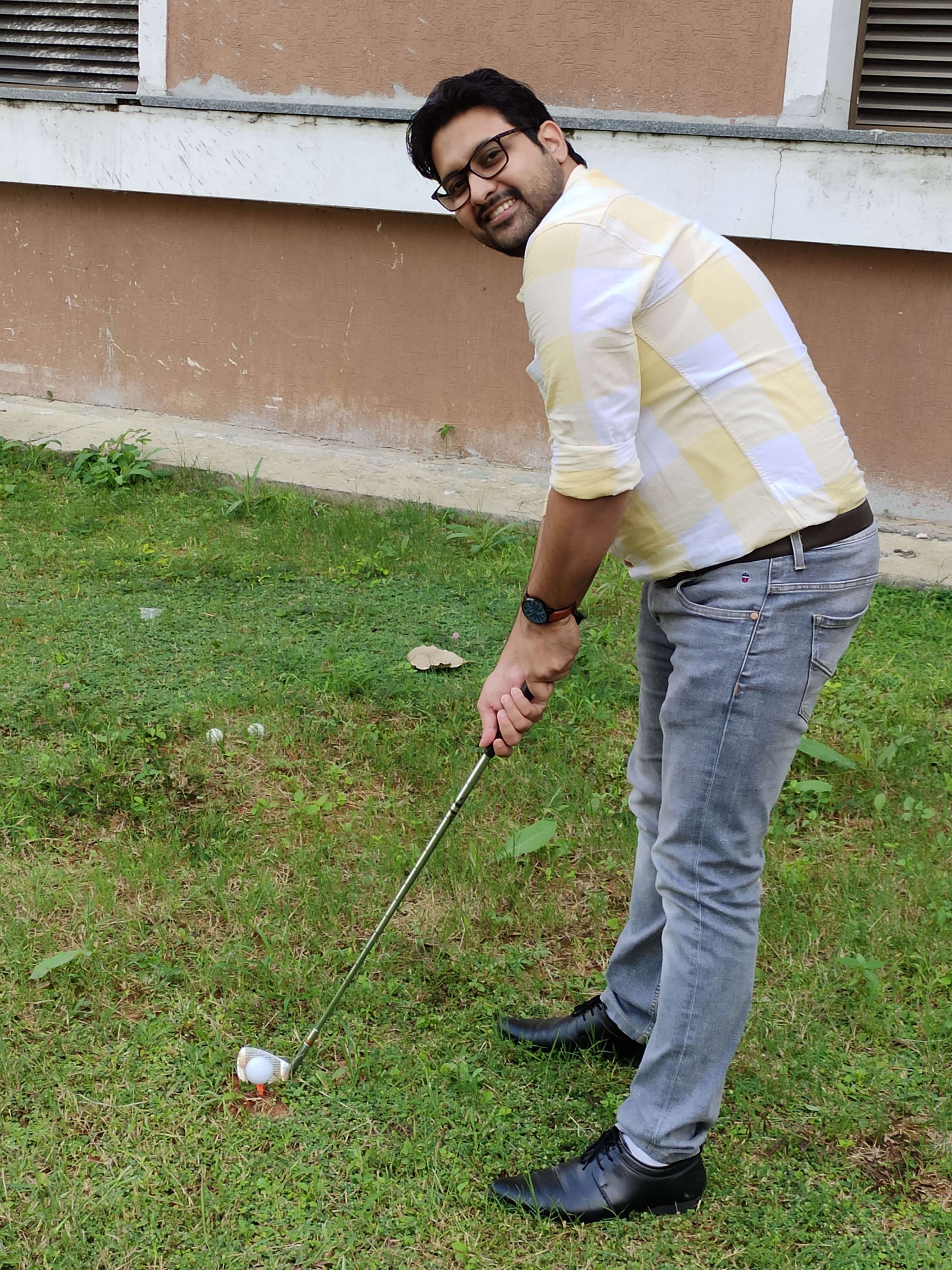


Prerona above, and Tanmmet in the pic below.. 


Teaching Tips

 My experience tells me that some of these work. Of course, you need to discover what works for your students, based on many factors. I have tried some of these (successfully, I think) in my classes over the years, mostly in higher education in management.

Instead of making a statement, ask a question. Wait for an answer. You can ask someone specific what he or she thinks about it, if there's no answer in a few seconds. Or, make a joke about why everyone is asleep, was the food good (if after lunch), or are they hungry (if before).

A joke always works, because if students have an overdose of dull classes one after the other in a day, they are looking for release. It gets their attention, almost always.

An activity promotes discussion, better than a moderated discussion or a general case discussion. You can always close with a moderated presentation or discussion after the activity, or a written submission and a discussion of a few of those. 

Feedback also helps. Immediate feedback for a presentation, or written comments in the class immediately after an assignment is the most useful.

Golf in Business Schools

Prof. Harsh Vardhan above, and Arunoday, Rajat Verma below, try out Golf

at NMIMS Bangalore.


                                                         and of course, I do too.


 I have always wondered why Golf is not part of a business school -either as a part of the curriculum, or as an extra-curricular activity. There are good reasons why they say Business School students are successful due to networking which happens there. If that is the case, networking skills also take you places later, in the corporate world. And Golf's a great way to go that way. 

We were plain lucky to have an 18-hole Golf course 500 metres from home at Kirloskar Institute, harihar. Thanks to the Kirloskars, we played Golf like millionaires do-everyday!

At IMT Nagpur, a few years later, I managed to construct a green by simply asking our normal landscaper to create one and maintain it! All we did was procure a cup to hold the ball, and a flagstaff! And we played till I was there, training quite a few students (girls included) and a few MDP participants! They all enjoyed it, without exception. 

At IIM Indore again, I played on our cricket field, with imaginary greens on either side. Natural tee boxes were at the elevated ends. Again, I took a few MDP participants and faculty to play-they all enjoyed it. Some students too, on request, and they are now my friends for life!

Why is it that we are reluctant to do things that might do the student morale a lot of good? 

Sharu Rangnekar-A Tribute

 One of India's early management conultants, Sharu passed away recently (late 2020/Jan. 2021). I first saw him and heard him in 1982 when he came down for a session during orientation for us doing MBA, at IIM Bangalore. Many years later, we invited him to speak at IMT Nagpur where I was Director at the time.

He was older, but had not lost his sense of humour and emphasis on the essentials. What he reiterated, and has said in his books (In the Wonderland of Indian Managers and others), is two things-

In teaching/learning, video or visuals work better than text or PPTs. Second, humour always works. He was the epitome of both. His lectures included screening some excerpts from his videos, which he had made many moons ago (ahead of his time there), and his humour was classy.

He also came to Pune in 2012, to release my autobiography at Crossword, courtesy Smita Dabholkar Singh, my colleague who organised the event. He was his usual self, and did not pull any punches. The event was a success, mainly due to him.

One of a kind! 

In a World of OTPs and KYCs

 And digital menus.. imagine these.. If you want to enter Heaven, you need to prove your credentials.. first, a KYC to prove your identity.....

These Were Liked a Lot